The Criterion Channel’s new collection for August, Grindhouse Gothic, focuses on director Roger Corman’s “Poe Cycle,” his 8 films in the first half of the 1960s adapted from stories by Edgar Allan Poe. The first of those, House of Usher, is arguably the most successful and the best.
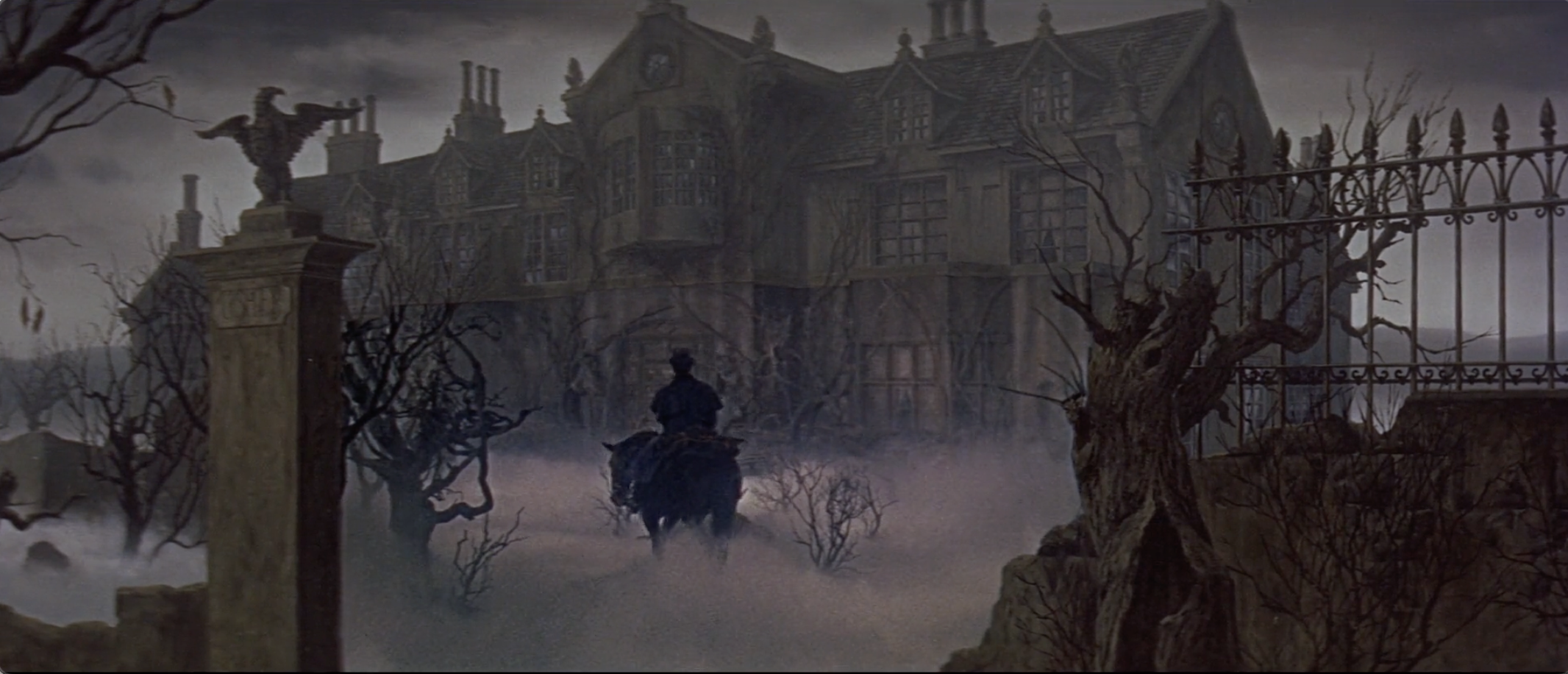
House of Usher is of course based on “Fall of the House of Usher”, and it was surprisingly faithful (though to be fair, I haven’t read it in some time). A young man, Philip Winthrop (a rather dull Mark Damon), visits the gothic estate of the Usher family to be with his fiancée Madeline Usher (Myrna Fahey). But something is very wrong in the house, beyond just the giant (metaphorical) crack splitting it in two. Her brother Roderick (Vincent Price) details the curse that has befallen the family and insists they must not marry, especially because she must not conceive. The family must come to an end because “the Usher line is tainted, Mr. Winthrop.” Philip realizes the danger he and Madeline are in and they decide to leave before all hell breaks loose. But of course it’s too late, all hell does break loose, and the fall of the house begins.
Roger Corman is known as one of the kings of low budget cult filmmaking, and I was prejudiced by those expectations. In reality this film is a gorgeous production, handsomely shot with lavish production design, steered by a tight script from the legendary writer Richard Matheson (I Am Legend, Duel, numerous episodes of The Twilight Zone). The film was shot in 1959 and released in 1960, in the waning years of the Hays Code, so while not up to the post-Psycho levels that horror films would reach, it is still a step beyond the bloodless fare major studios were putting out in the 1950s. Think of it as one of the best Hammer films that Hammer never made. House of Usher was a larger budget for Corman and a big risk for American International Pictures, but it would pay off handsomely, even if a full third of the budget was spent on just one actor. But what an actor. AIP and Corman were shooting for the moon on this one, and they landed it. Even though it’s really only four actors on a set co-opted from other productions, you can tell the production team is aiming for something bigger by the extended overture before the main credits, Les Baxter’s score booming over nothing but black (it was so jarring, I briefly thought Criterion had screwed up the film) which at the time was a technique reserved for more epic, big-budget fare like Spartacus, North by Northwest, and Ben-Hur.
A note must be made about Vincent Price. Growing up, I really only knew Price as that creepy old guy with the basso profundo voice from Michael Jackson’s Thriller video and his work in Edward Scissorhands. Here you really get to see his power as an actor. This is just about smack dab in the middle of his career, and he would go to do many more films with Roger Corman, including all of the Poe Cycle. As Roderick Usher he walks that fine line of a mustache-twirling villain and a man haunted by what he knows about the curses on his own family. He surely doesn’t want to bury his own sister (and based on a standard read of the Poe story, his lover) alive, but he does what he has to to end the madness. When Philip asks, “Is there no end to your horrors?” he truthfully answers, “No, none whatever.”
And hoo boy those paintings. When Roderick walks Philip through the madness that courses through the entire Usher family line, he shows him portraits of the various family members, and frankly they’re worth the price of admission alone. You can view several and an analysis of the art here. And like that art, the film is not afraid to get pretty weird. An extensive dream sequence as the film transitions to its final movement tempts Philip to join the rest of the doomed Usher family, with Roderick literally beckoning to him as the family members welcome him to hell. It’s a wonderful sequence, perhaps out of place with the rest of the film, but that’s kind of the point, I think.
 BradleyHerring.com
Leave a comment